Exploring physics during adolescence can spark long-lasting interest in science. This article highlights five top-rated teen-friendly physics books that explain complex concepts with clear visuals, real-world examples, and age-appropriate language. Each pick is designed to build a solid foundation while fueling curiosity about energy, motion, quantum ideas, and engineering. The selections balance accessible explanations with depth, helping teens connect theoretical ideas to everyday technology and future study paths.
| Product | Author / Brand | Format |
|---|---|---|
| The Way Things Work: Newly Revised Edition | David Macaulay | Illustrated Guide |
| Visual Learning: Physics | Kurt Baker | Illustrated Guide |
| The Physics of Energy for Beginners | AF Scientific Publications | Intro to Energy |
| Quantum Physics for Teens | Elian Crossfield | Intro to Quantum |
| Engineering for Teens | Pamela McCauley PhD | Engineering Basics |
The Way Things Work: Newly Revised Edition

This classic book uses engaging diagrams and humorous explanations to demystify how everyday machines function. David Macaulay’s narrative approach pairs with detailed illustrations to cover levers, gears, pulleys, and energy transfers. Teens gain a practical sense of physics by tracing the steps from a simple action to a complex system. The newly revised edition updates examples for modern technologies while preserving the playful, story-driven style that makes physics approachable for readers new to the subject.
Visual Learning: Physics: An Illustrated Guide

Kurt Baker’s Barron’s Visual Learning title emphasizes pictures, diagrams, and concise explanations to help teens grasp core physics ideas. From forces and motion to energy and waves, the illustrated format supports visual learners and provides quick reference points for homework or study sessions. The book’s approachable tone and modular sections make it practical for teens juggling school projects or curious weekend exploration. It’s a solid starting point before advancing to more mathematical treatments of physics concepts.
The Physics of Energy for Beginners

This accessible guide introduces energy concepts tailored to middle and high school students, including practical examples of kinetic, potential, and thermal energy. The book connects energy forms to real-world devices and everyday phenomena, helping teens appreciate how physics explains what they see around them. Clear language, short chapters, and visuals support gradual mastery of energy conservation, transfer, and efficiency—essential foundations for physics coursework and STEM explorations.
Quantum Physics for Teens
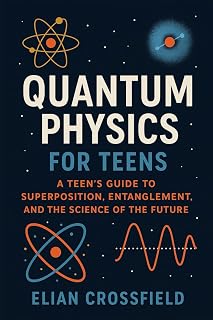
Elian Crossfield’s teen-focused introduction to quantum physics covers superposition, entanglement, and the scientific mindset driving quantum discoveries. The book translates abstract ideas into relatable concepts, with examples and simple experiments that illustrate probabilistic thinking and measurement challenges. It serves as a bridge from classical physics to the quantum world, enabling teens to appreciate how cutting-edge science shapes future technologies and interpretations of reality.
Engineering for Teens

Pamela McCauley PhD presents an approachable pathway into engineering concepts for teens interested in design, building, and problem-solving. The book combines fundamental physics with practical engineering projects, emphasizing how forces, energy, materials, and safety come together in real-world devices. Teens gain hands-on insights into the engineering process, from ideation and prototyping to testing and refinement, making it a useful companion for STEM clubs and school projects alike.
Buying Guide: Key Purchase Considerations
- Reading level and tone: Choose books that match the teen reader’s comfort with scientific language and preferred learning style (visual, textual, or hands-on).
- Illustrations and diagrams: Visual aids help learners grasp complex ideas quickly; consider books with clear diagrams and real-world examples.
- Progression and depth: Look for titles that gradually build from basic concepts to more advanced topics, enabling continued growth.
- Relevance to coursework: Books that align with standard middle and high school physics curricula can reinforce classroom learning.
- Projects and activities: Practical experiments or design challenges enhance engagement and practical understanding of physics.
- Accessibility: Some topics can be abstract; choose a mix of introductory and more detailed texts to cater to different readers’ needs.
Comparison At A Glance
- The Way Things Work (Illustrated, broad mechanical focus) – Best for visual learners seeking intuition about everyday machines.
- Visual Learning: Physics (Illustrated guide) – Great for quick reference and step-by-step visuals.
- The Physics of Energy for Beginners (Energy-centric) – Solid foundation in energy concepts with real-world relevance.
- Quantum Physics for Teens (Quantum concepts) – Bridges classical and quantum ideas with accessible explanations.
- Engineering for Teens (Engineering integration) – Connects physics with design and hands-on projects.