Hardbound lab notebooks offer durable construction, archival paper, and proven layouts that scientists, engineers, and students rely on for accurate record-keeping. The following five selections emphasize sturdy covers, quality paper, and thoughtfully designed pages to support data logging, experiments, and daily lab notes. Read on to compare features and choose the option that best fits your research style and writing preferences.
Product Overview
| Product | Brand | Pages | Cover Type | Paper | Notable Feature |
|---|---|---|---|---|---|
| Vela Sciences Advanced E7-C Expanded Hardcover Lab Notebook | Vela Sciences | 144 | Hardcover | 70lb/105gsm | Grid+ pages, index, charts |
| Vela Sciences Advanced S7-C Expanded ProCover Lab Notebook | Vela Sciences | 144 | Synthetic Leather Cover | 70lb/105gsm | Professional cover with ribbon marker |
| Vela Sciences Advanced E7-A Expanded Hardcover Lab Notebook | Vela Sciences | 144 | Hardcover | 70lb/105gsm | Dot Grid pages |
| Scientific Notebook Company, Laboratory Notebook, 192 Pages 3001HC Blue Hard Cover | Scientific Notebook Company | 192 | Hard Cover | 70lb/105gsm approx. | Smyth Section sewn pages |
| Thick Lined Journal Notebook 8.5×11″ with Big A4 Hardcover Leather | Of a Happy Kind | 300 | Hardcover Leather | Thick cream paper | Front/back pockets, tabs, pen loop |
Vela Sciences Advanced E7-C Expanded Hardcover Lab Notebook

The Vela Sciences E7-C expands on a permanent sewn-bound hardcover with a heavyweight board and a scuff-resistant matte cover. It includes an expanded information page, lab notebook guidelines, a pre-numbered index, and reference charts. The 105gsm paper minimizes bleed-through, while Line Grid+ pages support signature blocks and date blocks on every page for traceable records. This model emphasizes a solid writing surface and a durable spine for long-term use in busy lab settings.
Key features include: permanent binding, flat-back spine, and a robust layout designed for lab workflows. Users should test ink types on the cover’s surface and ensure compatibility with their preferred archival inks. The notebook’s grid-based pages are conducive to precise data plotting and experimental notes, with sections for abbreviations and equipment references.
Vela Sciences Advanced S7-C Expanded ProCover Lab Notebook

This model uses a professional synthetic leather ProCover paired with a permanent bound hardcover and a reinforced spine. It features the same lab-ready layout with an expanded information page, pre-numbered index, and Grid+ pages with signature and date blocks. The 70lb weight paper offers smooth writing experience while minimizing bleed-through, making it a reliable choice for day-to-day lab practice. Ink compatibility notes advise testing fountain pen inks beforehand.
Highlights include: durable ProCover, clear organization aids, and robust page spacing for detailed experimentation records. Consider your preference for a tangible hardcover aesthetic versus the lighter feel of softcover formats when selecting between this option and other hardbound notebooks.
Vela Sciences Advanced E7-A Expanded Hardcover Lab Notebook
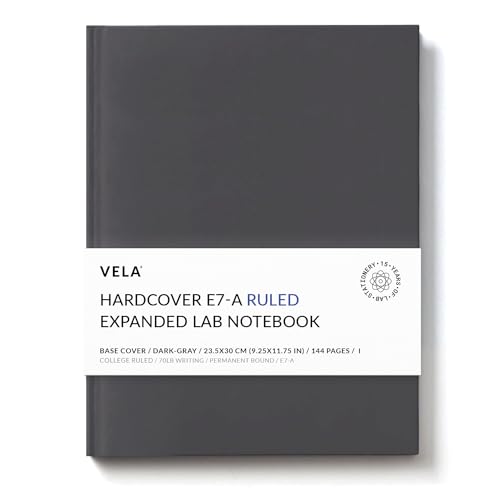
The E7-A variant combines a scuff-resistant matte laminated cover with an extra large writing surface provided by a solid rear board and reinforced binding. It uses standard Dot Grid pages and a comprehensive lab-ready layout that includes an index, reference charts, and equipment tables. The 105gsm paper is designed to minimize show-through and bleed-through, with guidance to test ink types—particularly fountain pen inks—before bulk use. It offers a reliable, professional notebook for structured experiments and data capture.
Considerations include: durability of the cover under field or bench conditions, compatibility with your preferred pens, and whether dot grid formatting better serves your note-taking style compared to line or grid formats.
Scientific Notebook Company, Laboratory Notebook, 192 Pages 3001HC Blue Hard Cover

This notebook emphasizes Smyth Section sewn pages for durability and organization. It features 192 numbered pages with a 1/4 grid and signature blocks for “Recorded by” and “Verified by.” The hard moisture-resistant blue cover adds external protection, making it a sturdy choice for labs, classrooms, and field work. The combination of sewn pages and grid structure supports meticulous data logging and traceability of experiments.
Key considerations include: how the grid layout aligns with your data capture needs, the availability of signature blocks for audit trails, and whether the sewn binding improves longevity in repeated use scenarios.
HAYDEN MCNEIL Student Lab Notebook Spiral Bound: 100 Carbonless Duplicate Sets

Note: This option is included for context as a related hardbound alternative. The notebook uses carbonless duplicate pages and spiral binding, making it well-suited for copying records, though it is not a bound hardcover. It can be a practical alternative for teams needing duplicate records and quick sharing of experimental results, but it does not meet the hardbound criterion strictly.
Buying Guide: Key Purchase Considerations
- Binding and durability: For long-term records, permanent sewn bindings and sturdy covers (hardcover or ProCover) resist wear in busy labs and field settings.
- Paper and bleed-through: Look for 70–105 gsm (approximately 105 gsm used here) to minimize ink bleed-through, especially when using markers or heavy inks. Test fountain pen inks if used.
- Page layout: Grid, dot grid, or ruled pages support different data capture styles. Pre-numbered indices, reference charts, and signature blocks improve traceability and audit readiness.
- Cover material: Matte laminated, synthetic leather, or traditional hard covers each offer different levels of grip, protection, and aesthetics. Choose based on handling conditions and appearance preferences.
- Ink compatibility: Archival inks are recommended for day-to-day lab use. Some inks may feather or bleed on certain papers, so testing on a small sample is wise.
- Size and portability: Consider whether the notebook’s dimensions fit your workspace, pocketing needs, or lab equipment constraints. A standard 9.25 x 11.75 inch size balances writing area with portability.
- Authoring flexibility: If you require duplicate records, carbonless or log-style pages may be beneficial, though they may conflict with hardbound archival goals.
- Audit and compliance: For regulated labs, notebooks with signature and verification blocks, as well as clear chronological indexing, help support compliance requirements.
Users should align their notebook choice with their typical workflow: data-heavy experiments may benefit from grid layouts and robust coverage, while teams seeking portable field notes may prefer lighter, leather-like covers with easy transport features. Consider also whether you value a premium cover aesthetic versus a more utilitarian design for rugged environments.