Exploring canon law requires reliable, scholarly resources that present the Code of Canon Law with clear annotation, study editions, and thorough commentary. This article highlights five highly regarded books that cover the Code of Canon Law from Latin-English editions to detailed commentaries. Each selection balances accessibility with depth, making them suitable for students, clergy, and researchers seeking precise doctrinal and legal guidance. The following summaries, features, and a buying guide will help you compare options and choose the right reference for your study or practice.
| Product | Editor/Author | Edition / Type | Notes |
|---|---|---|---|
| Code of Canon Law Annotated – 4th Edition | Juan Ignacio Arrieta (Author) | Annotated, 4th Edition | Concise annotations for study and reference |
| The Code of Canon Law | The Canon Law Society Trust (Author) | Standard edition | Trusted official presentation |
| New Commentary on the Code of Canon Law (Study Edition) | Beal, Coriden, Green (Editors) | Study Edition | In-depth commentary with study aids |
| Code of Canon Law: Latin-English Edition | Catholic Church (Author) | Latin-English Edition | Original text with English translation |
| The Code of Canon Law a Text and Commentary, Study Edition | James A. Coriden (Author) | Study Edition | Text with scholarly commentary |
Code of Canon Law Annotated — 4th Edition

The Code of Canon Law Annotated — 4th Edition offers practical annotations that help readers interpret canonical provisions within doctrinal and pastoral contexts. This edition is suitable for students and church professionals who need concise explanations alongside the text. It highlights how specific canons have been applied in contemporary cases, aiding quick reference during study or liturgical planning. The author, Juan Ignacio Arrieta, provides a structured approach to complex canons while maintaining accessibility for a broad audience.
- Edition: 4th
- Author: Juan Ignacio Arrieta (Author)
- Format: Annotated edition with focused notes
The Code of Canon Law

The Code of Canon Law from the Canon Law Society Trust presents a standard, authoritative edition that serves as a foundational reference for canonical scholars and practitioners. It consolidates the most essential canons into a cohesive text, suitable for classroom use, seminar discussions, and clerical study. This edition emphasizes reliability and accessibility, making it a staple on many reading lists for canon law students and professionals.
- Editor/Publisher: The Canon Law Society Trust (Author)
- Format: Standard Code of Canon Law edition
- Use: Core reference for study and practice
New Commentary on the Code of Canon Law (Study Edition)

The New Commentary on the Code of Canon Law (Study Edition) provides an extensive, layered analysis of canon law with scholarly commentary from editors Beal, Coriden, and Green. This edition is particularly valuable for advanced students and professionals seeking nuanced explanations of canons, cross-references to related disciplines, and practical implications for judicial and pastoral contexts. It blends text, commentary, and study aids to support in-depth learning.
- Editors: John P. Beal, James A. Coriden, Thomas J. Green
- Edition: Study Edition
- Strength: Thorough scholarly commentary with study aids
Code of Canon Law: Latin-English Edition
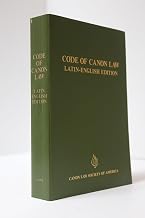
This Latin-English edition mixes the original text with a parallel English translation, facilitating precise study for bilingual readers, translators, and researchers who require access to canonical wording alongside interpretation. The Latin base ensures fidelity to the Code, while the English side enhances comprehension for those who rely on non-Latin sources in scholarly work or pastoral application. The edition is a practical choice for comparative study and cross-referencing.
- Authorship: Catholic Church (Author)
- Format: Latin-English edition
- Use: Bilingual study and translation reference
The Code of Canon Law a Text and Commentary, Study Edition

The Code of Canon Law a Text and Commentary, Study Edition combines the canonical text with scholarly commentary in a single volume. This format supports both direct study of canons and critical interpretation, making it suitable for seminar-style coursework and personal study. The study edition approach helps readers connect canonical provisions with doctrinal context and practical implications for ecclesial life and governance.
- Author: James A. Coriden (Author)
- Edition: Study Edition
- Advantage: Integrated text and commentary for seamless study
Buying Guide: Key Considerations For Canon Law Books
When selecting a canon law book, consider the following perspectives and criteria to match your goals:
-
<li Purpose and audience: Are you studying for class, teaching a course, or practicing canon law? Annotated editions and study editions cater to learners, while standard editions suit professionals needing a reliable reference.
<li Depth of commentary: Some titles emphasize concise notes and practical explanations, while others provide extensive scholarly discourse and cross-references. Choose based on your preferred depth and study needs.
<li Language and accessibility: Latin-English editions are valuable for precise wording and multilingual study. If you primarily read English, ensure the translation quality and commentary align with your expectations.
<li Editor/author credibility: Reputable publishers and experienced editors (such as canonical scholars and church bodies) enhance reliability and scholarly value for long-term use.
<li Format and portability: Consider physical vs. digital formats, page count, and how you plan to use the book in academic settings, libraries, or pastoral work.
<li Cross-referencing and indexes: Strong indexes, cross-references, and study aids (tables, charts, footnotes) improve navigability during research and writing.
<li Currency and edition updates: Canon law evolves with interpretations and practice; check the edition date to ensure alignment with current scholarly standards.
These perspectives help readers select a canon law book that balances authoritative text, helpful commentary, and study-friendly features, enabling effective learning and professional use in American ecclesial contexts.