Whether you’re studying contract law or sharpening professional skills, the right reference books help you grasp core concepts, analyze cases, and communicate more effectively. This guide highlights five top contract law books, drawing from trusted authors and case-driven materials to support learning, exam prep, and practical application. Each entry includes a concise overview, standout features, and how it supports different perspectives on contract doctrine, remedies, and interpretation.
| Product | Author / Brand | Key Focus |
|---|---|---|
| Contract Law For Dummies | Scott J. Burnham | Plain-language coverage of contract basics, essential terms, and practical scenarios |
| Problems in Contract Law: Cases and Materials | Charles L. Knapp, Nathan M. Crystal, Harry G. Prince, Danielle K. Hart, Joshua M. Silverstein | Case-driven exploration with study center access for deeper analysis |
| Contracts | Inc. Barcharts | Compact reference with essentials and quick-look guidance |
| Working with Contracts: What Law School Doesn’t Teach You | Charles M. Fox | Practical skills for applying contract law in real scenarios |
| Master Legal Vocabulary & Terminology | Marc Roche, IDM Law | Legal vocabulary, phrases, and templates for contracts |
Contract Law For Dummies
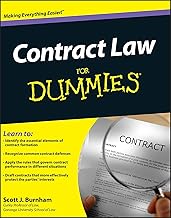
Contract Law For Dummies provides accessible coverage of foundational topics, including offer and acceptance, consideration, and breach. While designed for beginners, it also offers practical scenarios that help readers translate theory into real-world decision-making. The author uses straightforward explanations and real-life examples to demystify complex terms, making it a strong starting point for law students, paralegals, or professionals refreshing their knowledge. This edition emphasizes clarity, digestible chapters, and quick-reference summaries that support exam prep and everyday practice.
Problems in Contract Law: Cases and Materials

This Aspen Casebook presents a robust collection of cases and materials that illustrate contract law’s core doctrines. Its collaborative authorship covers a wide range of perspectives, enabling readers to compare how different jurisdictions and scholars approach issues like formation, interpretation, performance, breach, and remedies. The associated study center enhances engagement through supplemental problems, notes, and guidance, making it a strong option for upper-level courses and self-guided study that seeks a deeper, case-centered approach.
Contracts

Contracts by Barcharts offers a concise, user-friendly overview designed for quick reference and exam preparation. It emphasizes essential contract concepts, standard terms, and checklist-style guidance that helps readers identify key issues in a given scenario. This book suits students needing a compact companion for review sessions, as well as professionals who require a reminder of core principles without exhaustive detail.
Working with Contracts: What Law School Doesn’t Teach You

Working with Contracts focuses on practical application beyond doctrinal theory. It covers negotiation strategies, drafting considerations, and real-world decision-making that law students often encounter in internships or professional settings. The text aims to bridge the gap between classroom learning and the actual work of contract professionals, providing actionable tips, sample clauses, and scenario-based exercises to build confidence in contract analysis and drafting.
Master Legal Vocabulary & Terminology

Master Legal Vocabulary & Terminology focuses on the language used in contracts, including essential phrases, prepositions, and frequently used terms in legal drafting. The addition of templates and example documents helps readers develop clarity and precision in contract writing. This resource is especially helpful for readers seeking to improve drafting quality, avoid ambiguous terms, and communicate more effectively within professional contexts.
Buying Guide
When selecting a contract law book, consider your目的, current course level, and intended use. Here are key purchase considerations from multiple perspectives:
- Audience and purpose: Beginners benefit from accessible explanations (such as Contract Law For Dummies), while upper-level law students may prefer case-based materials (Problems in Contract Law) or compact references for quick review (Contracts by Barcharts).
- Depth vs. breadth: If you need deep doctrinal insight, prioritize casebooks with multiple perspectives. For a broad overview, choose concise guides that emphasize core concepts and practical drafting tips.
- Practical applicability: Books that include drafting templates, sample clauses, and negotiation scenarios help transform theory into practice, useful for internships and professional work.
- Supplemental resources: Some titles pair with study centers or online resources. These can enhance learning through exercises, problems, and interactive materials.
- Author credibility: Works by established law professors and practitioners tend to offer rigorous analysis and well-structured explanations, aiding long-term retention.
In evaluating these options, align your choice with your study plan and the specific contract topics you expect to encounter, such as formation, interpretation, breach, and remedies. A combination of a foundational guide, a case-based text, and a practical drafting resource often provides a balanced, robust understanding suitable for both study and professional use.