Choosing the right piano books can help adults build fundamentals, confidence, and joy at the keyboard. This guide highlights five well-regarded titles designed for adult beginners and late starters, combining clear instruction, practical theory, and approachable practice. Each entry includes key features to consider and how the book fits a self-study or guided-learning path.
Summary of Selected Products
| Product | Author / Brand | Main Focus |
|---|---|---|
| Alfred’s Basic Adult All-In-One Piano Course | Alfred Music | Structured course with lesson, theory, and technic; spiral-bound for easy use |
| Adult Piano Adventures: All in One Course – Book 1 | Nancy Faber, Randall Faber | Beginner method for adults with chords and notation; self-guided with audio |
| The Stress-Free Piano Method for Late Starters | Tom Harris | Beginner-friendly 3-in-1: basics, chords, exercises; quick daily routines |
| Piano Book for Adult Beginners | Damon Ferrante | Learn to read music, theory, and technique; includes streaming video |
| Learn Piano for Adult Beginners: 3 Books in 1 | Play ToWin | Compact 3-in-1 with audio and video for accelerated progress |
Alfred’s Basic Adult All-In-One Piano Course

Product features align with a comprehensive, user-friendly approach. The spiral-bound format supports easy handling on a music stand, and the course blends lessons with theory and technic in one volume. This structure helps adult learners solidify reading skills while practicing practical pieces. The authors bring decades of teaching experience, emphasizing repetition, tempo control, and accessible repertoire. The layout encourages consistent practice, with review sections to reinforce concepts as skills grow. It is suitable for self-study or guided lessons, providing a clear path from fundamentals to more intermediate pieces.
Adult Piano Adventures: All in One Course – Book 1
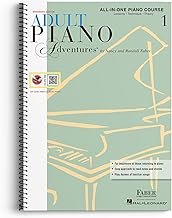
From the Faber method family, this book combines beginner-friendly notation with practical chords. It supports adult learners who want a single-volume pathway into reading music, rhythm, and basic harmony. The included theory and reading guidance helps reinforce daily practice, while the arrangement of pieces aims to motivate through familiar, approachable songs. The authors emphasize a balanced approach: develop technique without sacrificing musicality, and integrate audio resources for a listening model of proper expression and tempo. The book’s structure is friendly to self-learners or weekly studio instruction.
The Stress-Free Piano Method for Late Starters

This title presents a three-in-one approach: basics, chord work, and practical exercises designed for adult beginners. The program emphasizes a low-stress, steady progression, aiming to build confidence with short daily sessions. The structure supports learners who juggle other responsibilities by focusing on quick wins—often within ten minutes a day—while gradually introducing repertoire. This method can complement more formal study or serve as a full self-guided path, with exercises and songs chosen for accessibility and musical payoff.
Piano Book for Adult Beginners

Designed for self-guided learners, this book blends practical piano playing with music reading, theory, and technique. The included streaming video lessons add a visual layer to the learning experience, helping students observe hand positions, rhythm, and phrasing. The content aims to be approachable for adults returning to the instrument, with clearly explained concepts and gradually expanding repertoire. The book structure supports steady skill development, from basic scales and chords to more confident performance pieces.
Learn Piano for Adult Beginners: 3 Books in 1

This compact package combines three essential volumes into one convenient set, designed for rapid-paced progress. The program integrates audio and video resources to reinforce listening and imitation, a key element for adult learners focusing on accurate rhythm, phrasing, and technique. The inclusive approach covers reading, theory, and practical playing, enabling beginners to build a working toolkit for a variety of common pieces. The layout and pacing are intended to keep motivation high while laying a solid technical foundation.
Buying Guide: Key Purchase Considerations And Comparisons
When selecting piano books for adults, consider your current skill level, time commitment, and learning style. The best options share several common strengths: clear progression, a balance of technique and repertoire, and supportive resources such as audio or video.
- Course structure: Look for a logical sequence that starts with fundamentals and gradually introduces reading, rhythm, and technique. If you prefer a single volume, ensure it includes theory and practice pieces.
- Notation and chords: For adults, a method that integrates chord symbols with standard notation can speed up progress, especially if you plan to accompany or improvise.
- Repertoire selection: Pieces should be approachable and rewarding, with pieces that adults find engaging. Accessible songs help sustain motivation.
- Support materials: Audio, video tutorials, or online resources enhance understanding and provide models for phrasing and timing.
- Format and usability: Spiral bindings, clear layouts, and navigable sections reduce friction during practice sessions.
- Self-study vs. guided study: Some books are designed for independent learners; others pair with teacher instructions. Choose based on your learning environment.
- Progress tracking: Look for included exercises or review sections that help you measure growth and identify gaps to address in practice.
Overall, adult learners can benefit from a blend of instruction and practical play. The five titles covered here emphasize approachable entry points, consistent routines, and supportive resources. Depending on whether you want a comprehensive course, a focused method, or a combination of audio-visual aids, these options cater to diverse goals—from casual hobby playing to building solid reading and technique.