Art Deco remains one of the most visually striking design movements of the 20th century. This article highlights five authoritative books that cover decorative arts, architecture, interiors, and the cultural context of the era. Each title offers rich illustrations, scholarly insights, and accessible overviews for readers, designers, and collectors alike.
| Book | Author / Brand | Amazon Link |
|---|---|---|
| Art Deco Complete: The Definitive Guide to the Decorative Arts of the 1920s and 1930s | Alastair Duncan (Author) | Link |
| American Art Deco: Architecture and Regionalism | Carla Breeze (Author) | Link |
| Inside Art Deco: A Pictorial Tour of Deco Interiors from Their Origins to Today | Lucy D Rosenfeld (Author) | Link |
| Interior Style: Art Deco | Lucy Derbyshire, Jena Quinn (Authors) | Link |
| The Birth of Art Deco: Ruhlmann and the Hôtel du Collectionneur, 1925 | Jared Goss (Author) | Link |
Art Deco Complete: The Definitive Guide

The Art Deco Complete volume offers a thorough survey of the decorative arts from the 1920s and 1930s. It balances text and imagery to trace how designers merged modern materials with elegant geometry. Readers gain context on furniture, metalwork, glass, ceramics, textiles, jewelry, and fashion, with cross-references to influential movements and designers. The book emphasizes the global reach of Art Deco while noting regional adaptations that shaped local aesthetics. Its layout supports both casual readers seeking an overview and scholars pursuing detailed references.
Key strengths include chronological organization, high-quality illustrations, and accessible prose that demystifies technical terms. For researchers, the book often points to primary sources and museum collections, enabling deeper exploration. For designers, it highlights motifs like streamline forms, sunbursts, chevrons, and bold color palettes. The combination of historical narrative and visual richness makes this title a solid cornerstone for any Art Deco library.
American Art Deco: Architecture and Regionalism

This title concentrates on architecture and regional responses within the broader Art Deco movement. It examines how American cities interpreted the style differently across the country, from coastlines to inland districts. The book situates buildings, neighborhoods, and civic projects within their economic and social contexts, revealing how regional identity shaped Deco’s expression. Readers will find case studies, architectural plan illustrations, and biographical notes about influential architects who defined the era in North America.
As a reference work, it blends scholarly rigor with practical accessibility. It is well-suited for students of architecture, design historians, and enthusiasts who want to understand Deco beyond glamorous façades. The regional focus helps counterbalance a purely “universal” Deco narrative by highlighting local materials, technologies, and construction methods that influenced design choices during the period.
Inside Art Deco: A Pictorial Tour

This pictorial volume offers a visual journey through Deco interiors from their origins to contemporary interpretations. Its photography and period illustrations showcase rooms, furniture, lighting, textiles, and architectural details that define the style. The narrative weaves together design evolution with social history, helping readers see how Deco interiors reflected changes in leisure, gender roles, and consumer culture. The book is particularly strong for readers who learn visually and want to identify motifs in situ, from grand salons to intimate spaces.
Readers should expect a strong emphasis on interiors, including recurring motifs such as lacquered surfaces, geometric inlays, and luxurious materials. While primarily image-driven, the accompanying captions provide concise context that supports classroom use, gallery exhibitions, or personal collections. It serves as an excellent visual reference for designers seeking to recreate authentic Deco atmospheres with period-appropriate details.
Interior Style: Art Deco
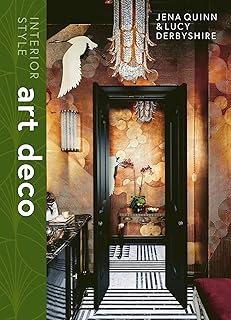
Interior Style: Art Deco surveys residential and commercial spaces with a focus on how Deco aesthetics translated into rooms and environments. The book combines practical design guidance with historical context, helping readers understand how furniture layouts, color schemes, lighting, and decorative surfaces contribute to the Deco atmosphere. It also considers contemporary reinterpretations, making it relevant for modern renovations or period-inspired projects. The authors compile substantial visual references, floor plans, and arrangement ideas to aid in planning authentic or inspired spaces.
The work is particularly useful for interior designers, architects, and students looking for a concise yet comprehensive overview of Deco interiors. It discusses materials, finishes, and production techniques typical of the period, and it highlights how globalization brought a mix of influences into interior design. The balance of historical analysis and practical suggestions makes this title accessible to both scholars and practitioners.
The Birth of Art Deco: Ruhlmann and the Hôtel du Collectionneur

This scholarly volume focuses on the Belgian-born designer Émile-Jacques Ruhlmann and the Hôtel du Collectionneur to illuminate the early development of Art Deco aesthetics. It blends design history with critical analysis of patronage, craftsmanship, and the social context of luxury interiors in the 1920s. The narrative traces how Ruhlmann’s refined materials, geometry, and high-end craftsmanship helped crystallize Deco’s elegant, modern identity—an important counterpoint to mass-produced Deco forms.
Readers will find detailed discussions of commissions, archival discoveries, and the relationship between architecture, furniture, and decorative objects. The book appeals to historians, curators, and collectors interested in the high-Art Deco trajectory, as well as designers seeking a deeper understanding of luxury materials and precision in period work. It offers a measured, documentary approach rather than speculative interpretation, making it a reliable source for informed study.
Buying Guide: Key Purchase Considerations
When selecting Art Deco design books, consider scope and focus. Some titles emphasize architecture and urban planning; others center on interiors, decorative arts, or fashion. Decide whether you want a broad survey, a regional study, or a deep dive into a single designer or project. Look for clear chronology, strong visual content, and well-annotated illustrations that help connect design motifs to historical context.
Edition quality matters for collectors and libraries. Favor books with high-resolution imagery, color accuracy, and durable paper. Indexing and reference sections are valuable for research, enabling quick cross-referencing of designers, artifacts, and architectural sites. For classroom or exhibition use, consider books with concise captions and accessible summaries alongside scholarly essays.
Practical considerations include format and availability. Large format, image-rich volumes are ideal for visual study, while compact editions suit on-the-go reference. Some titles are more museum-influenced, others more architectural. If possible, sample images or reader reviews can reveal whether the book’s tone matches your needs—academic, popular-leaning, or a balance of both.
Regional and historical nuance matters. Works focusing on American regionalism, European contexts, or cross-continental influences provide varied perspectives. Finally, verify author credibility and publication date to ensure content reflects current scholarship and current museum holdings. A well-chosen combination offers both a solid historical foundation and practical inspiration for contemporary design projects.